

Cart
0
DIY Enrichment Activities for Aggressive Chewers
DIY enrichment activities for aggressive chewers can add variety to a dog's routine while giving owners another way to encourage appropriate play and interaction.
Dogs chew for many different reasons, and chewing behavior varies greatly from one dog to another. Boredom can sometimes play a role, but chewing can also be associated with normal exploration, play, teething, individual preference, or other factors.
That's why enrichment shouldn't be treated as a guaranteed solution for destructive chewing. Instead, think of it as one part of creating an interesting and appropriate environment for your dog.
Start With Your Individual Dog
Before trying any homemade enrichment activity, consider how your dog normally interacts with objects.
Does your dog:
- Gently investigate new items?
- Immediately try to tear things apart?
- Swallow pieces instead of dropping them?
- Prefer food puzzles?
- Enjoy carrying toys?
- Lose interest quickly?
- Focus intensely on chewing?
Those behaviors matter when deciding which activities are appropriate.
An enrichment idea that works well for a gentle dog may be a poor choice for a dog that immediately attempts to swallow pieces.
DIY Doesn't Automatically Mean Safe
Homemade enrichment can be inexpensive and fun, but household objects weren't necessarily manufactured for use as dog toys.
That means supervision and common sense are especially important.
Avoid assuming that an item is safe simply because another dog owner uses it successfully.
Consider the size of the item, whether parts can detach, how your dog interacts with it, and whether the activity encourages your dog to swallow something that wasn't intended to be eaten.
Food-Based Enrichment
One of the simplest forms of enrichment is making mealtime slightly more interactive.
Instead of automatically serving every piece of kibble in a standard bowl, some of a dog's normal meal can sometimes be incorporated into an appropriate food-dispensing activity.
This can include commercially manufactured treat-dispensing toys or other feeding products designed specifically for dogs.
Always account for food used during enrichment as part of your dog's normal daily intake.
If your dog has dietary restrictions, food allergies, digestive problems, or another medical condition affecting diet, ask your veterinarian before introducing unfamiliar foods or treats.
Natural Chews Require Thoughtful Selection
Some owners use natural chews as part of their dog's enrichment rotation.
Red Rock Pet Supplies carries products such as the SCP Center Cut Meaty Natural Bone.

Natural chews aren't appropriate for every dog.
Hardness, size, ingredients, chewing intensity, and manufacturer recommendations should all be considered before offering one.
Never assume that a product described as natural is automatically appropriate for every dog or every chewing style.
Check the current product information and follow the manufacturer's directions for use and supervision.
Simple Search-and-Find Games
Enrichment doesn't have to involve building a homemade toy.
A simple search game can encourage a dog to use its nose and explore.
For example, you can place a few pieces of your dog's regular kibble in appropriate, easily accessible locations and encourage your dog to find them.
Start easy.
Once your dog understands the activity, locations can gradually become less obvious while remaining safe and accessible.
Avoid hiding food near household chemicals, electrical cords, small objects, medications, or other items you don't want your dog investigating.
Use the Environment You Already Have
Sometimes enrichment simply means changing how you use ordinary activities.
A walk can include additional opportunities to sniff.
A short training session can turn part of dinner into rewards.
A favorite toy can come out for an interactive play session rather than remaining available all day.
Even changing the order of familiar activities can provide variety.
Enrichment doesn't have to be complicated to be worthwhile.
Treat-Dispensing Toys
Commercially manufactured treat-dispensing toys provide another option for dogs that enjoy working for food.
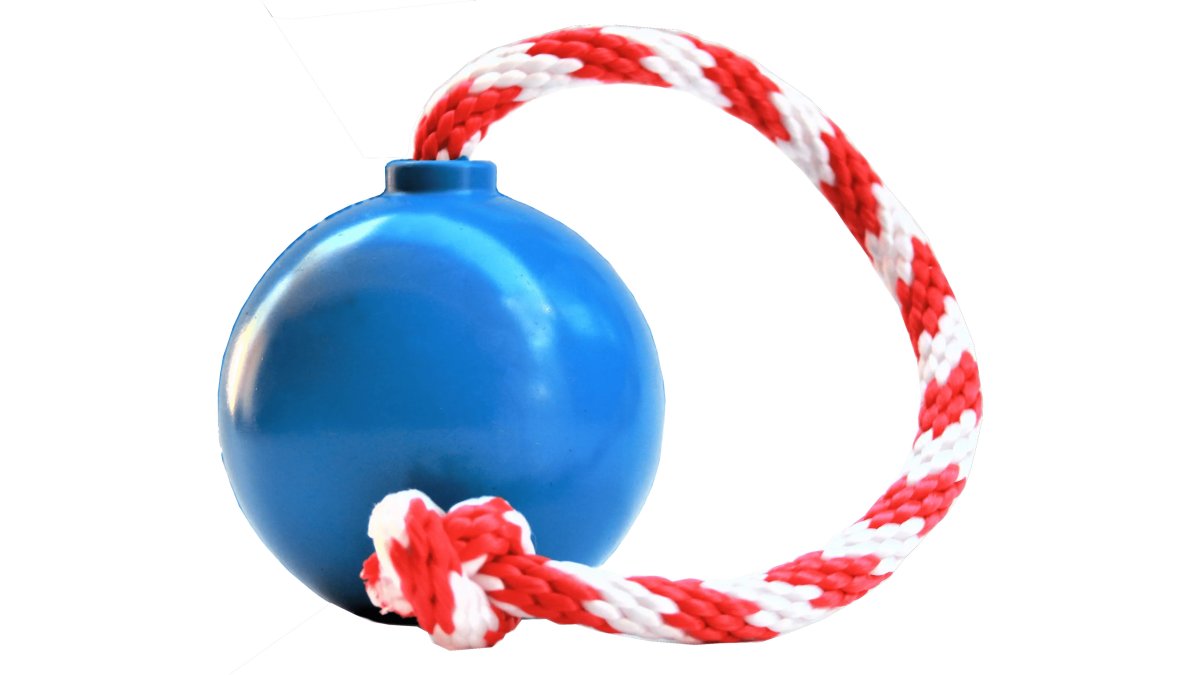
The USA-K9 Cherry Bomb Durable Rubber Chew Toy, Treat Dispenser, Reward Toy, Tug Toy, and Retrieving Toy is one example available from Red Rock Pet Supplies.

Because dogs vary in size and chewing intensity, review the current dimensions, materials, intended use, and manufacturer recommendations before choosing a toy.
“Durable” does not mean indestructible.
Inspect the toy as it is used and retire it if significant damage develops.
DIY Cardboard Activities: Know Your Dog
You've probably seen homemade enrichment ideas involving cardboard boxes, paper tubes, or crumpled paper.
For some dogs, supervised interaction with cardboard may provide an interesting activity.
For others, it's a poor choice.
A dog that attempts to consume cardboard, tape, labels, paper, or pieces of packaging shouldn't be encouraged to shred those materials.
If you experiment with a cardboard-based activity, remove staples, tape, labels, plastic pieces, and other packaging components first.
Supervise the activity and stop it if your dog begins swallowing the material.
When in doubt, use a product specifically manufactured for dog enrichment instead.
Be Careful With Homemade Puzzle Components
Homemade puzzles sometimes use tennis balls, plastic containers, cups, bottles, or other household objects.
These aren't automatically appropriate for every dog.
A strong chewer may quickly damage something that another dog only nudges with its nose.
Small or detachable components can also become problematic if a dog tries to chew or swallow them.
Before trying any DIY puzzle, ask:
- Is every component appropriately sized?
- Can anything easily break off?
- Is my dog likely to chew the container rather than solve the puzzle?
- Could my dog swallow part of it?
- Can I supervise the entire activity?
If the answers raise concerns, choose another activity.
Enrichment Without Food
Not every activity needs treats.
Depending on what your dog enjoys, enrichment can include:
- Sniffing during walks
- Short training sessions
- Fetch
- Tug using an appropriate toy
- Hide-and-seek with a familiar toy
- Exploring a new walking route
- Supervised play
- Practicing familiar cues
- Interactive puzzle toys
Experiment and see which activities genuinely hold your dog's interest.
Tug Toys and Interactive Play
Some dogs prefer interacting with their owners over working independently on a food puzzle.
A tug toy can provide another type of activity when used appropriately.
Red Rock Pet Supplies carries the Water Buffalo Horn Rope Tug Toy, which combines rope with a natural chew component.

Check the current product page for sizing, materials, care information, and recommended use.
Inspect rope and connection points regularly. If strands become significantly frayed or components become loose or damaged, stop using the product.
As with any toy, suitability depends on the individual dog.
Rotate Activities Instead of Buying Constantly
Enrichment doesn't require an endless supply of new products.
Rotating activities can help provide variety while keeping your dog's routine manageable.
You might alternate among:
- Interactive play
- A food-dispensing toy
- Training
- A sniff-focused walk
- An appropriate chew
- A puzzle activity
There is no universal rotation schedule.
Use your dog's interest and behavior as your guide.
Frozen Treat Toys
Some dog owners like freezing food inside toys specifically designed to hold treats.
If you want to try this, first verify that the manufacturer says the toy is appropriate for that use.
Choose foods already appropriate for your individual dog rather than relying on a generic internet recipe.
If using peanut butter, check the ingredient label carefully and make sure it does not contain xylitol, which is dangerous for dogs.
Dogs with dietary restrictions or medical conditions may need different choices, so consult your veterinarian when appropriate.
Avoid Turning Enrichment Into a Calorie Problem
Treat-based enrichment still counts as food.
Using a large amount of extra treats simply because they're hidden inside a puzzle can add unnecessary calories.
One simple approach is to use part of the dog's regular measured meal in an appropriate enrichment toy.
That provides the activity without automatically adding another snack.
Your veterinarian can help determine appropriate food amounts if you have questions about your dog's weight or diet.
Introduce New Activities Gradually
You don't need to make a new puzzle difficult on the first attempt.
Let your dog learn how the activity works.
If the challenge is too frustrating, simplify it.
If it's extremely easy, you can gradually adjust the activity while keeping safety in mind.
The objective is enjoyable interaction, not creating the hardest possible challenge.
Supervise New Enrichment Activities
Whenever you introduce something unfamiliar, watch how your dog uses it.
This is especially important for strong chewers.
A product or DIY activity may look perfectly appropriate until your dog discovers a way to dismantle it.
Observation helps you learn which activities are a good match and which ones should be removed from the rotation.
Inspect Enrichment Toys Regularly
Look over reusable toys for:
- Cracks
- Tears
- Missing material
- Loose parts
- Damaged openings
- Frayed rope
- Exposed internal components
- Significant changes in shape
If damage makes continued use questionable, replacing the toy is generally more sensible than trying to squeeze additional life from it.
Aggressive Chewing Isn't Always Boredom
It's important not to automatically label destructive chewing as boredom.
Dogs may chew for many reasons.
If chewing suddenly increases, becomes unusually intense, is accompanied by other behavioral changes, or results in your dog repeatedly consuming non-food objects, talk with your veterinarian.
A veterinary professional can help determine whether something beyond ordinary play or chewing behavior needs attention.
Exercise and Enrichment Work Together
Enrichment shouldn't be treated as a replacement for appropriate physical activity.
Dogs generally benefit from a combination of physical activity, social interaction, opportunities to explore, rest, training, and appropriate play.
The right combination depends on the dog's age, health, breed characteristics, environment, and individual personality.
There isn't a single formula that works for every dog.
Choosing Store-Bought Enrichment Toys
Store-bought products can be useful when you don't have time to create an activity or when household materials aren't appropriate for your dog.
When comparing products, look at:
- Size
- Materials
- Intended use
- Manufacturer warnings
- Treat compatibility
- Cleaning instructions
- Your dog's chewing behavior
Don't choose solely because something is advertised as being for an “aggressive chewer.”
The individual product still needs to be appropriate for your individual dog.
DIY Enrichment Activities for Aggressive Chewers
The best DIY enrichment activities for aggressive chewers are not necessarily complicated projects.
Sometimes the safest and easiest options are activities such as scent games, training, supervised interactive play, food-search games, or changing how you use an existing dog toy.
When household materials are involved, consider whether your dog is likely to investigate them or attempt to eat them.
The more destructive the dog, the more carefully DIY materials should be selected and supervised.
Build a Practical Enrichment Routine
A simple routine might include several different categories of activity throughout the week:
- Walks and sniffing opportunities
- Interactive play
- Short training sessions
- Food puzzles
- Appropriate chew products
- Search-and-find games
- Rest and downtime
You don't need to perform every activity every day.
Variety and suitability matter more than creating an elaborate schedule.
Final Thoughts
DIY enrichment activities for aggressive chewers can provide variety without requiring owners to constantly buy new toys.
The key is matching the activity to the individual dog.
For dogs that destroy household materials quickly, commercially manufactured dog toys may be a more practical enrichment choice than improvised DIY objects.
Red Rock Pet Supplies carries chew toys, treat-dispensing toys, tug toys, and other interactive products that can become part of a dog's enrichment rotation.
Check current product specifications and manufacturer recommendations before purchasing, supervise activities when appropriate, and regularly inspect reusable toys for wear.
Enrichment should make life more interesting for your dog—not unnecessarily complicated for you.
Frequently Asked Questions
What are safe DIY enrichment toys for aggressive chewers?
Stick to items that can't splinter or be swallowed in large pieces. A muffin tin covered with tennis balls works well for treat-dispensing. Cardboard boxes are fine for shredding as long as you remove staples and tape first. For DIY enrichment activities for aggressive chewers, avoid thin plastic bottles and anything with small parts that break off. Rotate toys every few days so your dog stays interested.
How can I mentally stimulate a dog that destroys everything?
Destruction usually means boredom plus excess energy. Try scatter-feeding kibble across a snuffle mat, freezing broth in a sturdy rubber toy, or hiding treats inside a cardboard box stuffed with paper. These activities make your dog work for food, which tires the brain faster than physical exercise alone. A 15-minute sniff-and-chew session can be as tiring as a 30-minute walk for many dogs.
Are cardboard boxes safe for aggressive chewers to shred?
Plain cardboard is generally safe in small amounts. Remove all tape, staples, and labels before giving it to your dog. Some dogs eat the cardboard instead of just shredding it, which can cause blockages. Supervise the first few sessions and take the box away once it's torn into small pieces. If your dog swallows chunks, switch to a frozen enrichment idea instead.
What are the best DIY frozen treats for dogs?
Mix plain yogurt, mashed banana, or low-sodium broth and freeze it in a rubber chew toy or silicone mold. For a longer-lasting option, layer peanut butter (xylitol-free) with kibble and freeze overnight. Frozen enrichment ideas for dogs work best in durable rubber toys that won't crack when frozen. Always check the treat fits your dog's size to prevent choking.

